This edition of The Ceres Edit brings together a selection of LinkedIn posts from across the Ceres team, spanning consumer behaviour, PR and social strategy, client activity, food innovation and the cultural trends shaping how we think about brands. From asking whether businesses are answering the questions consumers actually have, to making campaign moments travel further, using social trends with purpose and the enduring appeal of authenticity, these are some of the conversations shaping our thinking lately.
Naomi on whether brands are answering the question consumers are actually asking
Are brands answering the question consumers are actually asking?
A really interesting piece in The Grocer argues that the plant-based aisle may have been answering the wrong question, and it reminded me of a very ordinary trip to Sainsbury's.
My other half had decided he wanted hot dogs for dinner.
As we were working out what to buy, I remembered Shroomdogs. Mushroom sausages that Sainsbury's used to sell and that, for a period of time years ago, I was slightly obsessed with.
So off I went to find them. The thing is, neither of us had gone into the shop thinking: let's buy a plant-based sausage tonight. We were thinking: we fancy hot dogs.
And that's exactly the point the article made. Consumers don't always think in the categories brands and retailers create for them.
They're much more likely to be thinking: what are we having for dinner, what can I make quickly, what will everyone eat?
Then think about how often this happens in comms. As businesses, it's very easy to start with the things we want people to know about us. The product, the proposition, the proof points and the messages we've carefully agreed internally.
But the person we're trying to reach might be starting with a completely different question. They don't necessarily want to know everything that's interesting about our product, they want to know whether it answers a need they have right now.
We talk a lot in food and drink about putting the consumer at the heart of a campaign, but perhaps one of the simplest tests is: are we answering the question we want to answer, or the one they're actually asking?
Because sometimes the answer isn't “I want a plant-based sausage”, it's just “I fancy a hot dog”. 🌭
Read Naomi’s original LinkedIn post
Ceres on making a campaign moment travel further
How do you make a campaign moment travel further?
Earlier this summer, we helped Alaska Seafood Marketing Institute bring together two perfectly timed moments: the start of Alaska’s wild salmon season and the launch of the first direct Alaska Airlines route from Seattle to London.
First Flight, First Catch brought the story to life through PR, retail activity, influencer content, social media and a special London supper club.
And the story is still travelling…
This new Good Food partnership feature takes the campaign into a practical consumer setting, exploring what makes wild Alaska salmon so distinctive and extending the themes of taste, provenance and responsible fisheries management beyond the initial launch.
A lovely piece of content to see live, and a satisfying reminder that the strongest campaign ideas do more than create a moment. They provide a platform that can keep reaching new audiences.
You can read the feature here: https://lnkd.in/ev68c2sp
Read Ceres’ original LinkedIn post
Maddie on why the best social trends give brands a framework, not a script
The best social media trends don't tell brands what to say. They give them a new way to say it 👀.
I've been seeing the 'Kinda Chic' trend EVERYWHERE recently and, naturally, my brain immediately went to: how could our clients use this? 😂
For me, it isn’t about being able to spot trends; it's finding the connection between it and something that's already true about the brand, product or consumer.
With 'Kinda Chic', we've used the same trend in completely different ways. From talking about keeping walnuts in the fridge (yes, you have all been doing this wrong) to winning a Great Taste Award 🌟.
Same trend. Completely different messages.
And that's what I love about the best social trends. They give you the framework, not the script.
So here's my version... apparently it's kinda chic not to have everything figured out 💅.
Read Maddie’s original LinkedIn post
Naomi on why PR might be having a renaissance
PR is apparently having a bit of a renaissance.
And it was a piece in The Times by Daniel Woolfson that got me thinking about how much the industry has changed.
We've moved a long way from the old Absolutely Fabulous image of long lunches, schmoozing and “spin”. The reality now is rather less glamorous... More laptop time, more data, more reputation management, more AI, and probably more emails than any of us would care to count. 😂
But the interesting bit is that PR has also become much more important to businesses.
I've worked in the industry for 20+ years and think the biggest shift isn't in the tools we use, but in what clients need from us.
Yes, media coverage and creative ideas still matter, and I still love the thrill from seeing a great story land, but increasingly, so much of the value is in the thinking that happens before any of that.
Is this actually worth saying? Who needs to hear it? What might the reaction be? What are we missing? And sometimes, taking a leaf out of Ronan Keating’s book, should we be saying anything at all?
AI will make it quicker to draft the release, summarise the coverage or produce a first version of the plan, but it doesn't remove the need for judgement. If anything, I think it makes that judgement more valuable.
So yes, PR has become a little less Ab Fab. Less spin, more thinking, more context. And perhaps, as a result, more valuable.
I'll take that 😊
Read the article here: https://lnkd.in/eqNFPXYt
Read Naomi’s original LinkedIn post
Maddie on a snack brand that gets proposition and product right
It takes a lot for a new snack brand to stop me in the supermarket... 👀
Between working in food and drink marketing and spending far too much time wandering the supermarket aisles, I see a lot of new products.
But these RAISE Snacks Nut & Seed Clusters immediately caught my attention during our weekly Tasty Tuesday at work.
The branding stood out. The proposition felt different. And, importantly... they actually tasted great. My favourite was the Dark Chocolate & Sea Salt 🍫.
What really struck me wasn't just the flavour. It was how the brand positions itself.
It doesn't feel like it's asking you to choose between something that's healthy or indulgent. Instead, it feels like it's saying: why can't a snack offer both?
One pack contains 5.3g of fibre, yet it still feels like a proper chocolate treat.
It made me realise that some of the most interesting food brands aren't necessarily creating something completely new. They're changing the way we think about an existing category.
As someone who spends a lot of time thinking about food and drink marketing, I genuinely enjoy discovering brands that get both the proposition and the product right.
Great branding gets you to pick something up. Great products make you buy it again, and I think RAISE might have nailed both 👏.
Read Maddie’s original LinkedIn post
Ceres on discovering the possibilities of California Walnut cream
It’s been a little California Walnut-heavy in the Ceres kitchen this week… and we’re not complaining!
We had the pleasure of welcoming Chef Robert Danhi over from the States for a few days with California Walnuts UK / California Walnut Board & Commission. There may have been a little secret filming project too, but more on that another time…
What we can share was a brilliant California Walnut cream recipe and photography shoot in the Ceres kitchen.
Walnut cream is such an exciting concept for foodservice. Made from a simple base of just California walnuts and water, different consistencies can be created for a huge range of sweet and savoury applications, opening up all sorts of possibilities for chefs and operators.
Our home economist Nicky loved getting to grips with the technique, developing and creating new recipes for the shoot and, of course, having the opportunity to work alongside Chef Danhi. Chef, teacher, author and TV host.
Who knew walnut cream could inspire quite so much passion amongst a kitchen full of foodies? We certainly do now! 🤎
Read Ceres’ original LinkedIn post
Naomi on why our holiday photos say so much about food
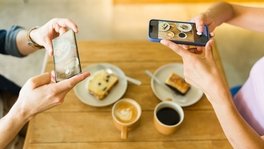
Apparently a third of Britons take more photos of their food on holiday than of the destination itself 📸.
I’m fairly sure I’m one of them. A self-confessed “phone eats first” kind of person, much to the annoyance of everyone else at the table who would quite like to get stuck in.
But it’s not just about having something nice for the camera roll. Food and drink become such a big part of how we remember a place. The restaurant you booked weeks in advance, the bakery you stumbled across... Or, in our family’s case, the enormous Mongolian pork chop my dad once ordered, closely followed by an equally enormous crackling pork leg. Both still get talked about years later 😅.
I’ve even been known to order a wine that isn’t on the wine list because I have a photo of the bottle from a previous trip and remember exactly how much I liked it.
Which is perhaps why this new survey from Chase feels so believable. And from a PR point of view, I love the simplicity of the story too. One stat, but one that immediately makes you think about, or question, your own behaviour.
So when I next come home with 200 photos of plates, wine labels and Cypriot cats, plus the occasional selfie with my family, I’ll know I’m not alone 😻.
What dominates your holiday camera roll: food, people, places... or cats? Please don’t let me be alone here!
Read Naomi’s original LinkedIn post
Naomi on the appeal of ‘nonna-maxxing’
There’s something about “nonna-maxxing” that I absolutely love 👵🧡
On the surface, it’s social media discovering the joy of watching Italian grandmothers roll pasta, knead bread, cook enormous meals and tell their grandchildren exactly what they are doing wrong... 🍝
But the appeal isn’t just about the food. These lovely nonnas aren’t trying to become influencers. There’s no content formula or performance for the camera. They are simply being themselves in their own funny, direct and knowledgeable way. They’ve spent decades cooking, feeding people and passing things down, and now we’re all being let in to watch.
Perhaps that’s why it feels so refreshing, in a world of curated feeds offering little in the way of reality 📱
A follow-up article in The Times asked why we aren’t celebrating British nans in the same way?
And while that might come with less sunshine and olive oil, the underlying values still feel very familiar: feeding people, making things last, looking after your own, maintaining friendships, passing on knowledge, saying what you mean and finding pleasure in simple things.
It made me think of my own nanny, who lived in Essex and was a proper character. She could knit anything and everything, passed down recipes including a family-favourite bread pudding, and always had the ability to say exactly what she thought 🧶💭! Not because any of it was designed to be content, but because those ordinary moments often become the things you most wish you had captured.
It’s nostalgia, of course. A fondness for people with character, knowledge built over a lifetime, food made without fuss and for humour that hasn’t been rehearsed.
The trend works because it starts with real people, real relationships and real lives. And the quickest way to spoil it would be to try to turn it into a formula... this isn’t an opportunity for every brand to find its own nonna or nan.
But I’d absolutely be here for a little more British nan-maxxing! 🇬🇧👵
Read Naomi’s original LinkedIn post
We’ll be back soon with the next edition of The Ceres Edit, bringing together more of the posts, perspectives and themes shaping our thinking at Ceres.